
Blooming
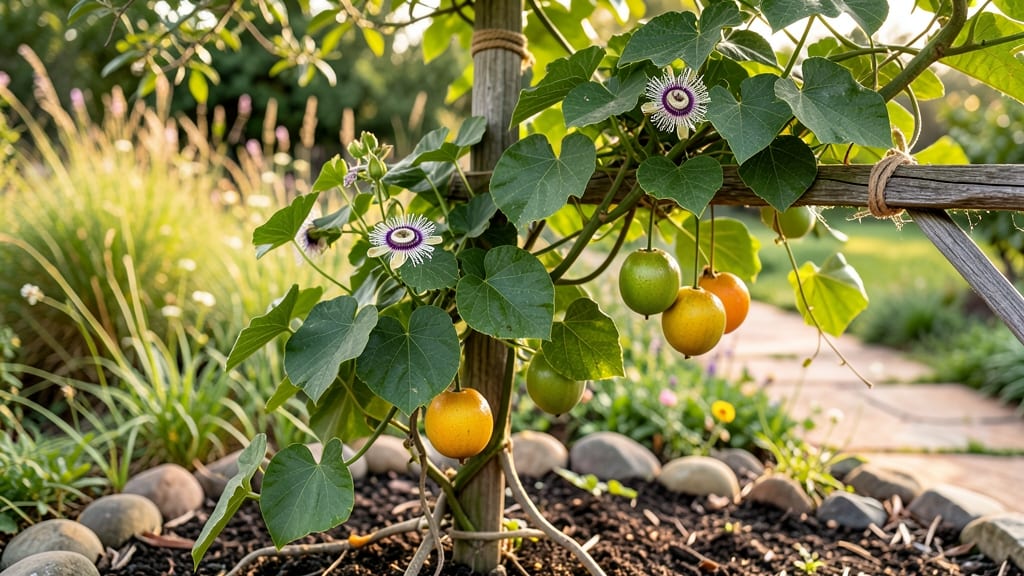
Blooming passion fruit flowers usually take 90 to 120 days to produce edible fruit, with ripening influenced by your local climate and specific variety. Look for a deep golden-yellow hue, slight give when pressed, and that signature tropical fragrance near the stem.
Passion fruit plants are fascinating because their fruiting timeline depends heavily on environmental factors. 🌿 In tropical climates, you might see fruit ready in as little as 80 days, while cooler regions could extend this to 150 days. The key is consistent temperatures above 60°F—below that, growth slows dramatically.
I've noticed that passion vines in containers often fruit slightly later than those planted in-ground because their root systems take time to establish in the new soil.
What's interesting about passion fruit ripening is how the plant signals readiness.
The color change from green to that vibrant yellow-orange is the most obvious cue, but the scent is what truly confirms ripeness. 🌸 When the fruit gives just slightly under gentle pressure (like a ripe avocado), that's your perfect window—usually just 1-2 days before it's too soft.
Overripe passion fruit loses its signature tangy-sweet flavor, becoming almost mushy, so timing is everything!
💡 In This Article
- Passion Fruit Flower to Fruit Timeline: Growth Stages Explained
- How to Check Passion Fruit Ripeness: Visual and Tactile Cues
Passion fruit flower to fruit timeline: growth stages explained
The journey from a blooming passion fruit flower to a ripe fruit involves a fascinating botanical process that unfolds in distinct stages. After successful pollination—typically by bees or wind—the fertilized ovary begins expanding rapidly, entering the fruit set phase that lasts about 2-3 weeks.
During this time, the flower's petals fall away, and the ovary swells into a small, green fruit roughly the size of a golf ball. This early growth phase is most sensitive to temperature fluctuations; drops below 50°F can cause the young fruit to abort and fall off the vine.
Once past the initial set phase, the fruit enters its rapid expansion stage, where it grows most dramatically—often doubling in size within 3-4 weeks.
This is when the plant's energy shifts from flower production to fruit development, and you'll notice the fruit's texture softening slightly as it fills with pulp. 🌿 The skin transitions from bright green to a muted yellow-green, and the fruit's weight becomes more noticeable.
In optimal conditions (full sun, well-draining soil, and consistent moisture), this stage accelerates, but drought stress or nutrient deficiencies can slow growth and lead to smaller, less flavorful fruits.
The final maturation phase spans the last 4-6 weeks before harvest, where the fruit's color deepens to that signature golden-yellow-orange hue. Internally, the seeds harden and the pulp develops its signature tangy-sweet flavor profile.
What's often overlooked is how the plant's energy management affects this stage—older vines may produce fruit that ripens more slowly, while vigorous young plants can rush through this phase in as little as 30 days in tropical climates.
The key factor here is photosynthesis efficiency; vines with abundant foliage can sustain faster ripening.
Not all blooms result in fruit due to a phenomenon called "flower drop," where up to 30% of flowers may fail to set fruit.
This happens when pollination isn't successful or when the plant's resources are already stretched thin from previous fruit development. 🌸 To maximize yield, I've found that providing supplemental pollination (gentle shaking of vines or introducing bees) and pruning to encourage air circulation can significantly improve fruit set rates.
The most productive vines often balance flower production with existing fruit load—too many blooms at once can lead to overburdened plants that drop flowers or produce small, underdeveloped fruit.
Understanding these stages helps explain why some passion fruit varieties ripen faster than others.
For example, the Purple Passion Fruit (Passiflora edulis) typically matures in 90-100 days due to its more aggressive growth habit, while the Sweet Granadilla (Passiflora ligularis) can take 120-150 days because it focuses energy on developing larger, sweeter pulp.
The difference comes down to genetic programming—some varieties prioritize speed over size, while others invest in flavor complexity through extended maturation.