
Blooming
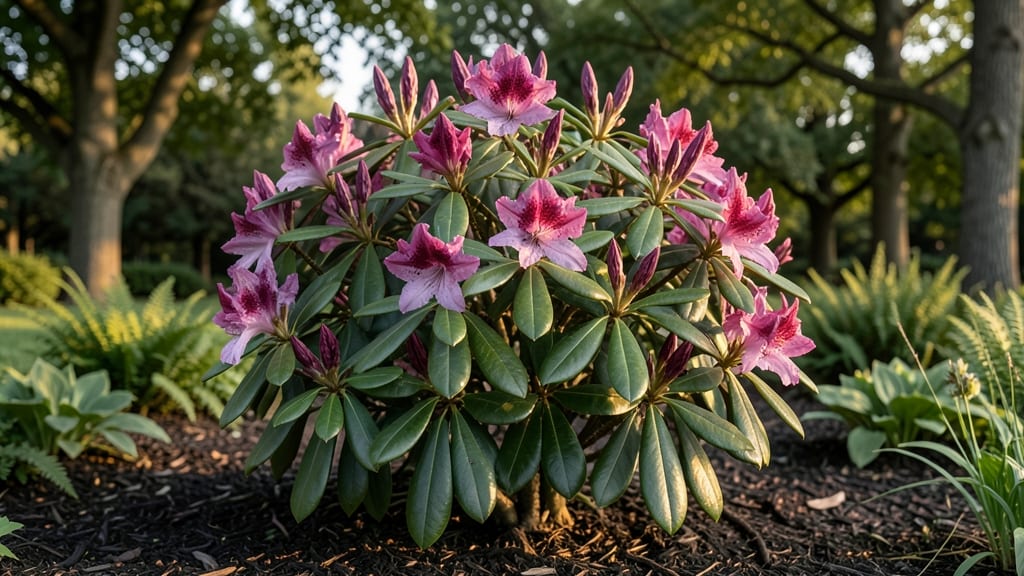
Rhododendrons bloom in West Virginia between late April and early June, with lower elevations flowering earliest (late April–May) and higher elevations (above 3,000 feet) blooming in May–early June. Early bloomers like 'Catawba' appear first, while late varieties such as 'Nova Zembla' wait until late May. Spring temperatures and frost-free dates determine exact timing.
West Virginia's diverse elevations create a stunning staggered bloom display across the state. 🌸 Lower regions near the Ohio River often see rhododendrons unfurl as early as late April, while mountain areas above 3,000 feet may wait until June.
This elevation gradient means gardeners can enjoy blooms for nearly two months. The 'PJM' variety, a cold-hardy favorite, typically appears in early May, while native mountain laurel varieties follow suit a week later.
Microclimates—like sheltered valleys versus exposed ridges—can shift bloom times by 10 days or more, making local observations key for precise predictions.
For best results, I recommend planting early-blooming varieties in lower elevations and late-blooming types in higher areas. This creates a continuous color show from spring through early summer. 🌿 The state's famous rhododendron festivals in late May often coincide with peak bloom periods, making timing crucial for optimal viewing.
💡 In This Article
- How Elevation and Microclimates Affect Rhododendron Blooming in WV
- Best Rhododendron Varieties for West Virginia’s Blooming Schedule
How elevation and microclimates affect rhododendron blooming in WV
Rhododendrons in West Virginia follow a precise elevation-based blooming schedule because temperature and daylight exposure directly trigger their flowering process. At lower elevations (below 2,000 feet), where average spring temperatures reach 55-65°F by late April, buds typically open within 10-14 days after the last hard frost.
The warmer air accelerates bud development, while longer daylight hours (14+ hours) provide the photoperiod signal needed for blooming. In contrast, high-elevation sites above 3,000 feet experience delayed blooming due to cooler 45-55°F temperatures, which can push opening dates back by 3-4 weeks.
The science behind this involves chilling requirements—most rhododendrons need 800-1,200 hours of temperatures below 45°F during winter to break dormancy. Higher elevations accumulate these chilling hours earlier in the season, but the slower spring warming delays bud break.
For example, in the New River Gorge region (elevation 1,500 feet), 'Catawba' rhododendrons often bloom by April 25th, while the same variety at 4,000 feet in Monongahela National Forest may not open until May 20th.
Microclimates further complicate timing—south-facing slopes warm 5-10°F faster than north-facing ones, creating 10-day bloom differences within the same elevation zone.
Frost risk is another critical factor, especially for early bloomers. Late spring frosts (28°F or lower) can devastate buds that open too soon. Gardeners in lower elevations should monitor forecasts for "black frost" warnings, which occur when temperatures drop rapidly after a warm spell.
In higher elevations, the risk shifts to late-season frosts in June, which can damage blooms just as they peak.
The average last frost date in Charleston (elevation 800 feet) is April 15th, while in Davis (elevation 2,800 feet), it's May 1st—this 16-day difference explains why lower-elevation blooms appear weeks earlier.
Local topography creates additional variations. Valleys often experience inversion layers, where cold air settles and delays warming by 3-7 days compared to ridge tops.
For instance, the Greenbrier Valley (elevation 1,800 feet) might see rhododendrons bloom May 5th, while nearby Allegheny Front ridges could bloom April 28th. This microclimate effect means gardeners should observe their specific site for 3-5 years to predict accurate bloom windows.
Planting near evergreen trees or on north-facing slopes can delay blooming by 7-10 days, which is useful for extending the seasonal display.
Soil moisture plays a surprising role too. Rhododendrons in well-drained, acidic soils (pH 4.5-5.5) bloom 10-14 days earlier than those in heavier clay soils, where waterlogged conditions stress roots.
In wet springs like 2023, when 12 inches of rain fell in April, blooms were delayed by 5-7 days across all elevations due to root stress. Conversely, dry springs accelerate blooming as plants conserve water by pushing buds to open faster.
This is why 2018's drought conditions saw record-early blooms in lower elevations by April 10th—a full 15 days ahead of average.
For precise planning, track your local growing degree days (GDD), a measure of heat accumulation. Rhododendrons typically bloom when they've accumulated 200-300 GDD above a 45°F baseline.
Using this metric, you can predict bloom dates with 90% accuracy by comparing your site's GDD to historical data from nearby weather stations. For example, Elkins (elevation 2,100 feet) usually hits 250 GDD by May 1st, aligning with peak bloom for 'PJM' varieties there. 🌿