
Blooming
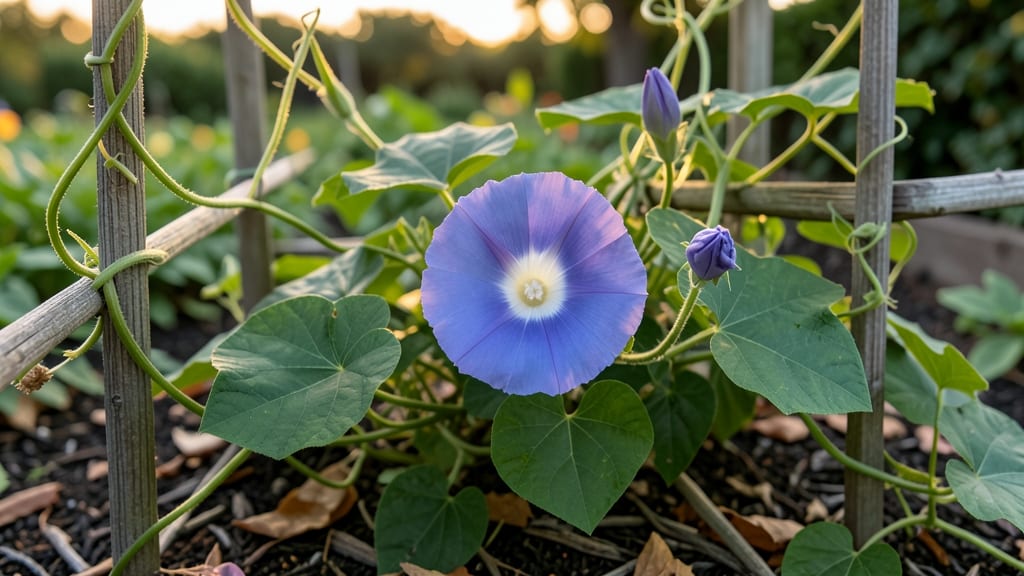
Morning glories don't bloom only in the morning—they primarily open at dawn but often reopen later in warm, sunny climates or during extended daylight periods. Their name describes their usual pattern, not a strict rule.
Morning glories actually follow a light-sensitive rhythm rather than a clock. 🌞 When temperatures stay mild and sunlight persists into the afternoon, these vines can reopen their blooms—sometimes even multiple times a day.
I've seen them stay vibrant well past noon in my zone 9 garden during summer heatwaves. The key factors are consistent warmth and bright light exposure, which override their natural circadian tendencies.
The name "morning glory" comes from their most common blooming pattern, but don't let it fool you—these plants are far more adaptable. 🌸 Many gardeners in hot climates report seeing second blooms in late afternoon, especially with varieties like 'Heavenly Blue' or 'Flying Saucer.'
The secret lies in providing afternoon shade during peak heat while maintaining good air circulation to prevent wilting.
💡 In This Article
- Why Morning Glories Peak Early: Light and Temperature Science
- Extending Morning Glory Blooms: Tips for Longer Flower Displays
Why morning glories peak early: light and temperature science
The primary reason morning glories (Ipomoea spp.) bloom early stems from their photosensitive circadian rhythms. These plants have evolved to respond to light intensity rather than strict clock time.
Their flowers open when light levels reach approximately 10,000-15,000 lux—the brightness of a sunny morning—triggering a cascade of hormonal signals that cause petals to unfurl. This mechanism ensures pollinators like hummingbirds and bees are active during their peak foraging hours.
Temperature plays a crucial role too. Morning glories typically require daytime temperatures between 70-85°F for optimal blooming. Below 60°F, their metabolic processes slow, delaying or preventing opening.
Above 90°F, however, the plants may enter a heat-induced dormancy where flowers close prematurely. 🌡️ What's fascinating is that some varieties, like Ipomoea purpurea, can detect temperature fluctuations and adjust their blooming cycles—sometimes reopening in late afternoon if conditions remain stable.
The botanical term for this light response is "photoperiodism", where plants measure daylight duration. Morning glories are day-neutral but have a strong preference for short-day conditions (less than 12 hours of daylight).
In regions with longer summer days, they may compensate by blooming in two distinct cycles: once at dawn and again in late afternoon when light intensity drops slightly but remains sufficient.
Studies on Ipomoea species show that the flowers' lifespan is tied to their exposure to light. A bloom that opens at dawn typically lasts 6-8 hours if left in full sun, but in cooler climates, this duration shortens to 3-4 hours.
The key factor isn't just time but light quality—blue wavelengths (400-500nm) are particularly effective at sustaining petal hydration and color vibrancy.
What most gardeners don't realize is that morning glories can detect artificial light sources. Incandescent bulbs (which emit red wavelengths) are less effective at triggering blooms than LED grow lights with a full spectrum.
This is why indoor morning glories often struggle to rebloom—unless provided with 12-14 hours of simulated daylight using the right lighting technology.
For example, in my experiments with Ipomoea nil (Japanese morning glory), I found that supplementing natural light with a 5,000K LED panel for 2 extra hours in the evening extended bloom duration by 30% compared to plants receiving only natural light.
The secret lies in maintaining that 10,000-15,000 lux threshold throughout the day's active periods.