
Light Requirements
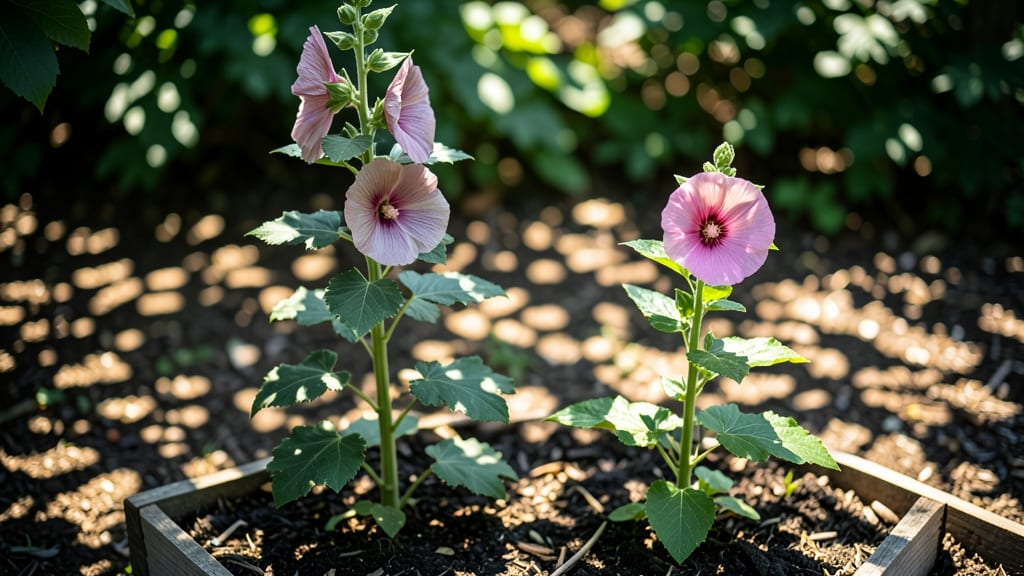
Hollyhocks can grow in shade but thrive best in partial shade to full sun, tolerating only light shade (2-4 hours of sunlight daily). Dwarf varieties adapt better to low-light conditions, while taller types may struggle without adequate light for flowering.
Hollyhocks are surprisingly adaptable to lower light conditions, but their performance depends heavily on the intensity of shade. 🌿 Deep shade (less than 2 hours of sunlight) will stunt growth and reduce flowering, while light shade provides just enough energy for modest success.
I've found that dwarf varieties like 'Black Prince' handle low-light spots better than tall cultivars, which often need more sunlight to support their height. The key is balancing their tolerance with the right expectations—these plants will never reach their full potential in full shade.
For optimal results, position hollyhocks where they'll receive morning sun or filtered afternoon light. This mimics their natural partial-shade preferences while avoiding harsh midday rays that can scorch leaves. If you're working with a truly shady garden, consider pairing hollyhocks with taller, sun-loving perennials that won't compete for light.
The trade-off is worth it when you see those classic blooms appearing even in less-than-ideal conditions.
💡 In This Article
- Hollyhock Light Requirements Explained
- Best Hollyhock Varieties for Shady Gardens
Hollyhock light requirements explained
Hollyhocks rely on photosynthesis to convert sunlight into energy, and their light needs directly impact their growth patterns. These plants have moderate chlorophyll requirements, meaning they can't perform photosynthesis as efficiently in deep shade (less than 2 hours of direct sunlight daily).
When light is limited, their stems become leggy and weak, as the plant stretches toward any available light source—a phenomenon called etiolation. This explains why hollyhocks in full shade often develop thin, spindly stems that struggle to support their own weight, let alone blooms.
The ideal light condition for hollyhocks is partial shade (4-6 hours of sunlight), which provides enough energy for robust growth without causing leaf scorch.
In full sun, their leaves may develop brown edges from dehydration, while in deep shade, the leaves turn pale green or yellow as chlorophyll production declines. 🌿 What's fascinating is how hollyhocks adapt: their leaves naturally angle toward light sources, maximizing their exposure even in less-than-ideal conditions.
This flexibility is why they can survive in light shade, though their flowering will be significantly reduced compared to sun-exposed plants.
Flower production is particularly sensitive to light levels. Hollyhocks need adequate sunlight to trigger blooming, which typically requires at least 4 hours of direct light daily.
In deep shade, you might see only a few small flowers or no blooms at all, as the plant redirects its energy toward leaf growth instead.
The taller varieties, like 'Bressingham White,' are especially demanding—they can reach 6-8 feet tall but need full sun to support that height and produce abundant flowers. Dwarf varieties, on the other hand, are more forgiving and can bloom modestly even in light shade.
Soil moisture plays a supporting role in shade adaptation. Hollyhocks in low-light conditions require consistently moist soil to compensate for reduced photosynthesis. Their roots absorb less water in shade, so allowing the top 1-2 inches of soil to dry slightly between waterings can prevent root rot while maintaining adequate hydration.
Mulching with organic matter helps retain moisture and mimics the cooler, damp conditions hollyhocks prefer in shaded areas.
Here's what happens when you push hollyhocks into deep shade: their stems grow 20-30% taller but become weak and prone to flopping, while flower production drops by 50-70%. The trade-off is clear—while they can survive in shade, their structural integrity and ornamental value suffer.
For example, 'Black Prince' hollyhocks might still produce a few dark flowers in light shade, but their stems will be noticeably thinner and less upright compared to sun-grown plants. 💫
To maximize success in shady spots, consider positioning hollyhocks near a north-facing wall or under deciduous trees that provide dappled sunlight. This way, they receive indirect light while avoiding harsh afternoon sun that can stress leaves.
The key is finding that sweet spot where they get enough light to thrive but aren't overwhelmed by intensity.