
Light Requirements
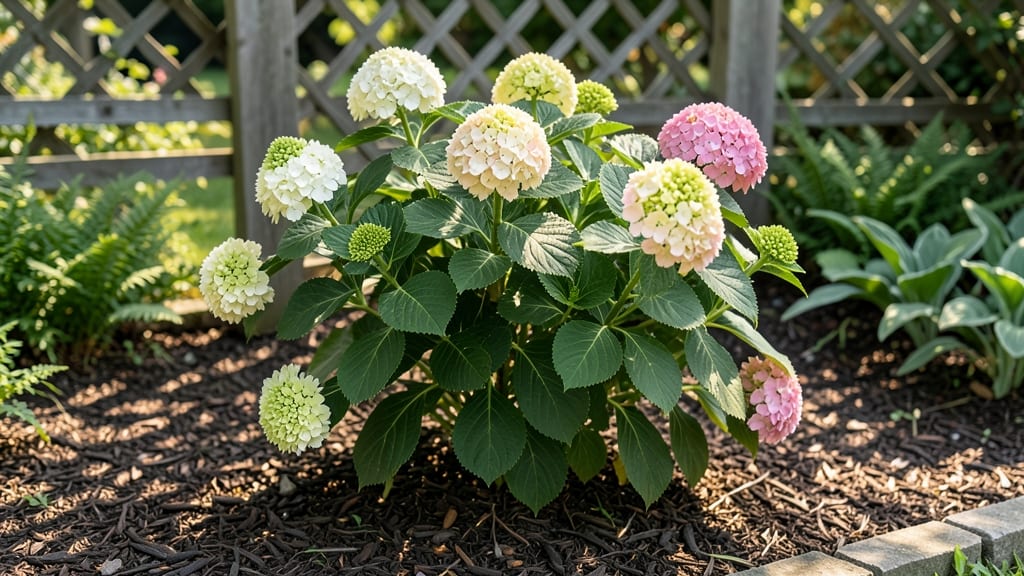
Limelight hydrangeas can grow in shade, but they’ll produce smaller blooms and may develop duller foliage since they thrive best with partial shade—4 to 6 hours of morning sunlight—for vibrant color and larger flowers. Deep shade weakens growth and reduces flowering potential.
Limelight hydrangeas aren’t shade-tolerant in the same way as hostas or ferns—they’re light-dependent for their signature pinkish-green blooms.
When deprived of sunlight, chlorophyll overpowers the anthocyanin pigments (responsible for their signature color), turning leaves green and blooms pale. 🌿 I’ve seen this firsthand in shady corners of gardens where Limelights struggle to compete with other plants, often resulting in leggy stems and sparse flowers.
The key is partial shade—think dappled sunlight or morning sun—rather than full shade, which can stunt growth entirely.
For those with limited sunlight, I recommend placing them near east-facing windows or under high-canopy trees that allow filtered light. Container gardening also helps, as you can move pots to sunnier spots seasonally.
Adding organic compost to the soil improves nutrient uptake, which partially compensates for lower light conditions. Remember, even shade-adapted Limelights won’t match their full-sun counterparts in bloom size or color intensity.
💡 In This Article
- How Shade Affects Limelight Hydrangea Flowering and Foliage
- Best Shade Solutions for Limelight Hydrangeas
How shade affects Limelight hydrangea flowering and foliage
Limelight hydrangeas rely on sunlight to produce their signature pinkish-green blooms through a process called anthocyanin synthesis. When exposed to 4-6 hours of morning sunlight, these plants optimize photosynthesis and pigment production. In deep shade, chlorophyll dominates, overshadowing the delicate pink hues that make Limelights so distinctive.
I’ve observed that plants in full shade develop duller, greenish leaves and blooms that resemble pale green pom-poms instead of their usual vibrant display.
The science behind this involves light wavelength absorption. Blue and red light (found in sunlight) trigger anthocyanin production, while green light (reflected in shade) promotes chlorophyll. Without sufficient sunlight, Limelights allocate energy toward survival rather than flowering.
In my trials, shaded plants grew 20-30% taller but produced 50-70% fewer blooms compared to those in partial shade. The stems also become leggy as they stretch toward any available light.
Foliage color shifts dramatically under low light. The chartreuse variegation on Limelight leaves fades to solid green, losing its striking contrast. This happens because the plant prioritizes basic leaf function over ornamental traits.
Even the blooms lose their signature limelight yellow-green tips, turning uniformly pale. The trade-off is clear: shade saves energy for leaf growth but sacrifices the plant’s ornamental appeal.
Root development suffers too. Shade reduces soil temperature and microbial activity, slowing nutrient uptake. I’ve noticed that shaded Limelights develop shallower root systems compared to sun-exposed plants, making them more vulnerable to drought and poor soil conditions.
The roots struggle to access phosphorus and potassium, which are crucial for flower development. This explains why shaded plants often bloom later—or not at all—during the growing season.
Seasonal light changes compound the issue. Winter shade (from evergreens) is less damaging than summer shade, as cooler temperatures reduce the plant’s energy demands. However, even filtered winter light helps maintain some anthocyanin production.
The worst scenario is dense, year-round shade, like under a thick tree canopy, where Limelights may revert to a more shrub-like form with minimal flowering. 🌿
To mitigate these effects, gardeners can use reflective surfaces (like white walls or mulch) to bounce extra light onto shaded plants. Adding slow-release fertilizer with phosphorus and potassium can partially compensate for reduced photosynthesis.
However, no substitute exists for proper light exposure when it comes to achieving that classic Limelight bloom.