
Light Requirements
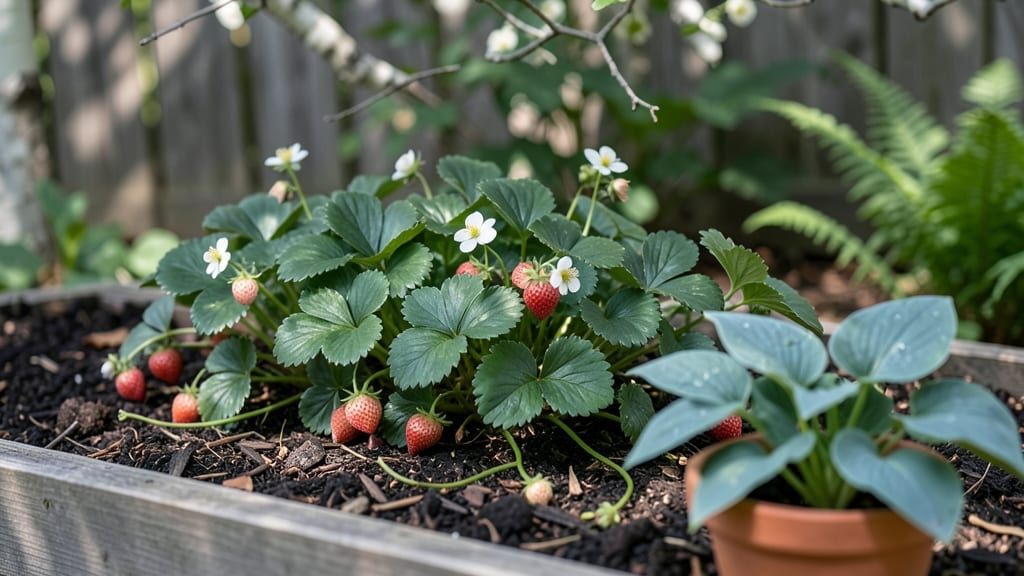
Strawberries can grow in shade, though they produce fewer berries and smaller fruit. Varieties like 'Albion,' 'Ozark Beauty,' and 'Shenandoah' tolerate partial shade, requiring at least 4-6 hours of indirect sunlight daily for optimal growth and fruiting.
Growing strawberries in shade is possible, but their productivity drops significantly because these plants rely on sunlight for photosynthesis to fuel fruit development. 🌱 The varieties mentioned—'Albion,' 'Ozark Beauty,' and 'Shenandoah'—are specifically bred to handle partial shade better than others, but even they won't match the yield of sun-loving types.
If you're working with limited light, focus on providing well-draining soil, consistent moisture, and a spot with morning sun exposure to give your plants the best chance at survival and modest fruiting.
For maximum success, consider planting these shade-tolerant varieties along fences or under deciduous trees where they'll get filtered light. The trade-off is worth it if you're determined to grow strawberries in low-light areas, as even partial yields can be rewarding for home gardeners with space constraints.
💡 In This Article
- How Shade Affects Strawberry Growth and Fruit Production
- Best Low-Light Strawberry Varieties for Shady Gardens
How shade affects strawberry growth and fruit production
Strawberries thrive in full sun because their photosynthesis process demands 6-10 hours of direct sunlight daily to produce the energy needed for fruiting.
In shade, their leaves receive less than 50% of the light intensity compared to full sun, which triggers a survival response: the plant prioritizes leafy growth over fruit production.
This is because photosynthesis in shaded conditions produces less glucose, forcing the plant to allocate energy toward maintaining existing foliage rather than developing berries. 🌿
The science gets even more interesting when you look at chlorophyll activity. Strawberry leaves contain two types of chlorophyll—Chlorophyll A and B—that absorb light most efficiently in the blue (400-500nm) and red (600-700nm) wavelengths.
Shade filters out these critical wavelengths, forcing the plant to rely on less efficient green light (500-600nm), which reduces overall energy capture by up to 40%. This energy deficit directly impacts fruit size and sugar content, often resulting in berries that are 30-50% smaller and less sweet.
What most gardeners don't realize is how shade affects the plant's hormonal balance. Lower light levels trigger increased production of auxin, a growth hormone that promotes vegetative growth (more leaves and runners) at the expense of fruit set hormones like gibberellins.
This explains why shade-grown strawberries often produce longer, thinner leaves and fewer, smaller berries. The trade-off becomes even more pronounced in deep shade (less than 4 hours of light), where flowering may be nearly nonexistent. 🌱
Comparing full-sun vs. partial-shade growth patterns reveals striking differences. In full sun, strawberries develop thicker, more compact leaves with higher chlorophyll density, while shaded plants grow lankier stems and leaves that appear pale green or yellowish.
The berries themselves show dramatic differences: sun-grown fruit develops richer red pigmentation (from anthocyanins) and a firmer texture, while shade-grown berries often remain pale and mealy. The sugar-to-acid ratio also shifts, with shaded fruit tasting more tart due to reduced sugar synthesis.
Temperature plays a hidden role in shade-grown strawberries. Shaded areas often maintain cooler soil temperatures by 5-10°F compared to full sun, which can delay flowering and fruiting. The cooler conditions also slow down the plant's metabolic rate, further reducing energy available for fruit development.
This is why shade-tolerant varieties like 'Albion' produce better yields in partial shade—they've been bred to maintain more efficient photosynthesis in cooler, lower-light conditions. 🌡️
For gardeners working with limited light, understanding these mechanisms helps set realistic expectations. While you can grow strawberries in shade, the key is to maximize the quality of light they receive.
South-facing windows or east-facing garden beds provide the best indirect light, while north-facing spots (in the Northern Hemisphere) offer the least beneficial light spectrum. Reflecting surfaces like white walls or light-colored mulch can increase light availability by up to 30%, making a noticeable difference in plant health and fruiting.
The bottom line? Shade reduces strawberry productivity by limiting photosynthesis, altering hormonal balance, and creating cooler growing conditions. However, with the right varieties and careful light management, you can still enjoy a modest harvest—just don't expect the same abundance as sun-loving plants.
The secret lies in working with the plant's natural responses rather than against them. ✨