
Blooming
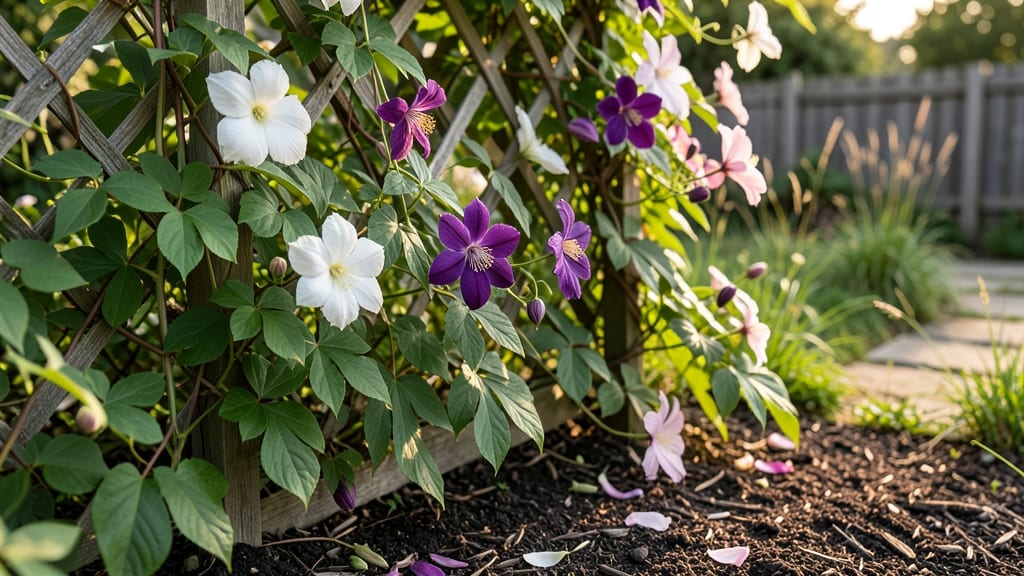
Clematis don't bloom all summer long; most varieties flower in one or two distinct seasons, with early, mid, or late bloomers depending on the type. Pruning spent blooms can encourage reblooming in certain varieties like 'Jackmanii' or 'Nelly Moser'.
Clematis flowering patterns are all about timing—think of them as seasonal performers rather than year-round stars. 🌸 Early bloomers like Group 1 varieties (e.g., 'Alionush') put on their show in spring, while late bloomers such as Group 3 types (e.g., 'Comtesse de Bouchard') shine in summer and fall.
The key difference lies in their growth habits: early bloomers flower on previous year's wood, while late bloomers rely on current season's growth. This means your pruning strategy should match the variety—cutting back too early can mean missed blooms, while waiting too long might shorten the display.
For example, 'Jackmanii' (a Group 3 variety) will reward you with multiple flushes if you deadhead promptly, but 'Alionush' (Group 1) needs minimal pruning to avoid sacrificing next year's flowers.
Here's where things get practical: deadheading isn't just about looks—it's a conversation with your plant. 🌿 When you remove spent blooms from reblooming varieties, you're telling the clematis to redirect energy into new flowers rather than seed production. The catch?
Timing matters—wait too long, and the plant may have already allocated resources to seeds. For non-rebloomers like Group 1 types, deadheading actually does more harm than good, as it removes potential next-year blooms.
Always use clean, sharp pruners and make cuts just above a healthy leaf node to encourage strong regrowth.
💡 In This Article
- Clematis Bloom Cycles by Variety Type
- Deadheading and Pruning for Extended Clematis Blooms
Clematis bloom cycles by variety type
Clematis flowering behavior is determined by their botanical classification into three main groups, each with distinct seasonal patterns. Group 1 varieties like 'Alionush' bloom on previous year's wood in early spring, typically from April to June, and produce flowers only once per season.
Group 2 varieties such as 'Jackmanii' bloom mid-season on current year's growth, often from June to August, with potential for a second flush if deadheaded properly.
Group 3 varieties like 'Comtesse de Bouchard' shine in late summer to fall, from July to September, also flowering on current season's growth.
The key difference lies in their growth habits: Group 1 flowers form on dormant buds, meaning aggressive pruning can remove next year's blooms entirely. Group 2 and 3 varieties, however, produce flowers on new growth, allowing for more flexible pruning schedules.
This is why Group 1 varieties often have shorter bloom seasons—just 4-6 weeks—while Group 3 varieties can extend their display for 8-10 weeks when conditions are optimal.
Climate zones play a crucial role too: in cooler regions (USDA zones 4-6), blooming may start 2-4 weeks later than in warmer zones (7-9).
What most gardeners don't realize is that clematis flowering is also influenced by temperature fluctuations. These plants require a period of winter dormancy to set flower buds for the following season.
In mild winter climates (zones 8-10), Group 1 varieties might experience less pronounced dormancy, leading to weaker spring blooms. The same applies to Group 3 varieties in hot summer climates—they may struggle to produce second flushes if temperatures exceed 90°F (32°C) for extended periods.
This is why 'Jackmanii' often performs better in cooler summer regions.
Here's how to identify your clematis type: Group 1 varieties typically have larger, more robust stems that flower early, while Group 2 and 3 varieties have thinner, more flexible stems that produce flowers later in the season.
The leaf arrangement also differs—Group 1 leaves are often opposite, while Group 2 and 3 leaves are alternate. 🌿 Understanding these distinctions helps you tailor your care approach, from pruning timing to fertilizer application, to maximize your plant's blooming potential.
Consider these seasonal patterns when planning your garden:
- Spring (March-May): Focus on Group 1 varieties for early color bursts
- Summer (June-August): Group 2 and 3 varieties take center stage
- Fall (September-November): Group 3 varieties often provide late-season interest