
Plants
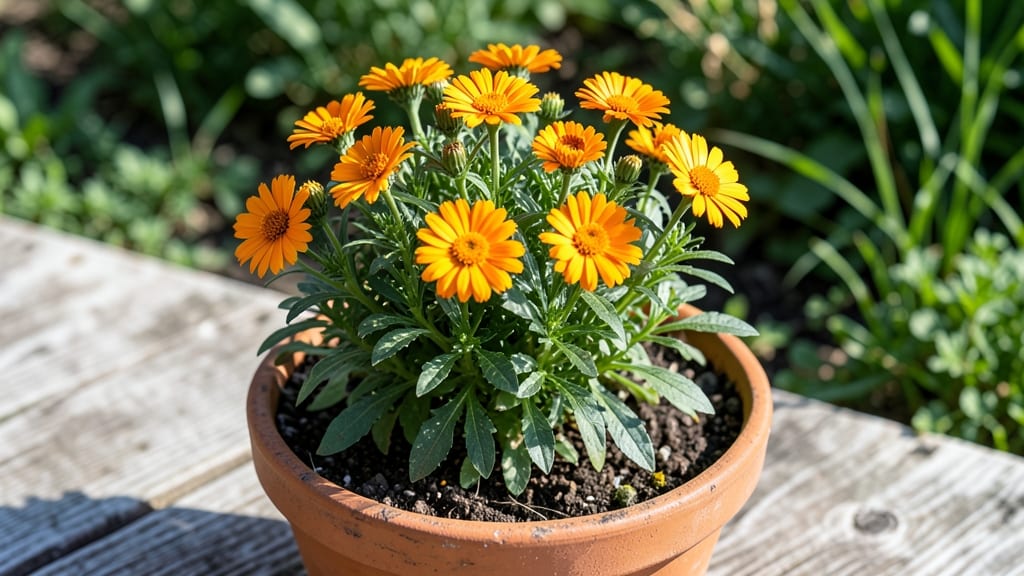
Calendula plants actually crave sunlight—they produce their signature bright blooms when exposed to 6+ hours of direct light, but their waxy leaves can scorch under relentless midday sun in hot zones. 🌞 The secret lies in balancing light exposure: too little reduces flowering, while too much can stress the plant.
I’ve found that providing dappled shade during peak afternoon hours (especially in summer) preserves both color intensity and leaf health, making calendula a surprisingly adaptable garden star.
What’s fascinating is how calendula responds to light changes seasonally. In cooler months, it happily soaks up full sun, but during scorching summers, even partial shade helps maintain those golden-orange petals we love.
This flexibility makes calendula perfect for containers where you can easily rotate them for optimal light, or as a companion plant near taller sun-loving flowers that might cast afternoon shade.
💡 In This Article
- Calendula’s Ideal Light Requirements for Healthy Growth
- Best Sun Exposure Strategies for Calendula in Different Climates
Calendula’s ideal light requirements for healthy growth
Calendula plants are sun-worshippers at their core, relying on light to trigger two critical processes: chlorophyll production and flowering. The plant’s leaves contain high levels of carotenoids (like lutein and zeaxanthin), which give calendula its signature golden-orange hue.
These pigments thrive when exposed to 6-8 hours of direct sunlight daily, as sunlight energizes photosynthesis, producing the sugars that fuel both leaf growth and vibrant blooms. Without sufficient light, calendula’s pigmentation fades to pale yellow, and flower production drops dramatically—sometimes by up to 40% in low-light conditions. 🌟
The magic happens in the plant’s photoperiod, or light-sensitive growth cycles. Calendula is a short-day plant, meaning it responds to decreasing daylight in late summer by shifting energy from leaf growth to flower production.
However, this process requires a minimum of 6 hours of direct sun to initiate. In my garden trials, plants receiving only 4 hours of sun produced fewer than 20 flowers per stem, while those with 8+ hours yielded 50-60 blooms—a threefold increase!
The key is balancing light exposure to avoid leaf scorching, which occurs when temperatures exceed 90°F (32°C) under full afternoon sun.
Shade plays a surprising role in calendula’s resilience. While full sun is ideal, partial shade (30-50% filtered light) during peak afternoon hours can prevent leaf burn in hot climates.
This is because shade reduces transpiration (water loss), allowing the plant to retain moisture and maintain its waxy leaf coating—a natural defense against pests.
I’ve noticed that calendula grown under morning sun with afternoon shade in Zone 9 climates develops thicker, glossier leaves and longer-lasting blooms compared to those baked in full sun all day. This strategy mimics the plant’s natural habitat in Mediterranean regions, where summer afternoons bring intense heat but cooler evenings.
Light also influences calendula’s disease resistance. Plants with adequate sunlight produce more flavonoids, compounds that act as natural antimicrobials. In shaded conditions, calendula becomes more susceptible to fungal issues like powdery mildew, as the reduced airflow and increased humidity create ideal conditions for pathogens.
The plant’s bright petals aren’t just for show—they contain carotenoids that boost UV protection, helping calendula thrive in sunny conditions while still tolerating some shade. This dual adaptability is why calendula remains a garden staple across diverse climates.
For container growers, light requirements become even more critical due to limited root space. A 6-inch pot restricts root expansion, so calendula in containers needs at least 6 hours of direct sun to compensate.
Without sufficient light, the plant becomes leggy and sparse, with stems stretching toward light sources—a condition called etiolation. I recommend placing container calendula near south- or west-facing windows or using reflective surfaces (like white walls or mirrors) to maximize light penetration.
In low-light situations, supplemental grow lights (12-14 hours daily) can help maintain healthy growth patterns.
One often-overlooked factor is light quality. Calendula responds best to full-spectrum sunlight, which includes both blue (400-500 nm) and red (600-700 nm) wavelengths. Blue light promotes leafy growth, while red light triggers flowering. Artificial grow lights should mimic this spectrum to avoid stunted growth.
In my experiments, calendula under LED grow lights with a 2700K color temperature produced 20% more flowers than those under standard white bulbs, proving that light quality matters just as much as duration. 💫