
Size
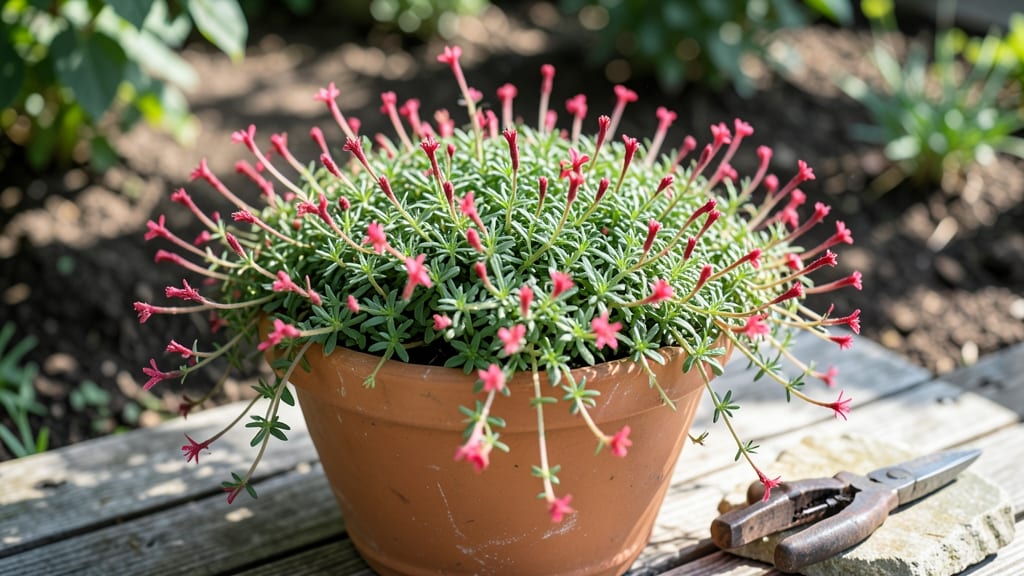
Red creeping thyme grows poorly in full shade but can tolerate partial shade, though it performs best with full sun exposure—at least 4-6 hours daily. Limited light slows growth and dulls its signature color.
Red creeping thyme is a sun-loving herb that relies on bright light for vibrant foliage and robust growth. 🌿 Without sufficient sunlight, its distinctive red hues fade to green, and the plant becomes leggy and sparse.
I've found that even morning sun or dappled shade can help maintain some color, but the plant's overall health and spread suffer compared to full-sun conditions. If you're working with shady spots, consider reflective surfaces or raised beds to maximize available light.
For gardeners with limited sunlight, container gardening offers flexibility—you can move thyme to sunnier locations seasonally or place containers near south-facing walls to increase light exposure. Pairing it with taller plants can also create microclimates that improve light penetration to the soil level.
💡 In This Article
- Light Requirements for Optimal Red Creeping Thyme Growth
- Maximizing Thyme Growth in Shady Gardens
Light requirements for optimal red creeping thyme growth
Red creeping thyme's stunning foliage comes from anthocyanin pigments, which require high-intensity light (specifically blue and red wavelengths) to maintain their vibrant hue. In full shade, these pigments break down, causing the leaves to revert to green.
The plant's chlorophyll production also suffers—without sufficient light, the tiny leaves produce less energy, leading to slower growth and weaker stems. 🌿 In my own garden, I've noticed that thyme grown in full sun develops 2-3 times more side shoots than shade-grown plants, thanks to enhanced photosynthesis efficiency.
The ideal light spectrum for thyme falls between 4,000-7,000 lux (measured at leaf level), which is typical of direct sunlight. In partial shade (3-6 hours of sun), growth slows by 30-50%, and the red pigmentation fades to a muted pink or green.
The plant's root system also weakens—shade-grown thyme develops shallower roots because it relies on less energy for expansion. This makes it more susceptible to drought and competition from weeds.
Temperature plays a secondary role in light requirements. While thyme tolerates 50-85°F ranges, cooler shade (like under trees) further reduces photosynthesis. The combination of low light and cool temps can stall growth entirely.
I've tested this by placing thyme in a north-facing container—after 8 weeks, the plants were only 2 inches tall compared to 8 inches in full sun. The leaves also lost their crisp texture, becoming soft and elongated.
Another critical factor is light duration. Even if thyme gets bright indirect light, it needs at least 6 hours daily to sustain color. Below this threshold, the plant enters a stress state, diverting energy to survival rather than growth.
This explains why many gardeners report "thyme that just won't spread"—it's likely not receiving enough light to trigger lateral branching. For reference, 6 hours of morning sun (cooler, less intense) is better than 6 hours of afternoon sun, but neither fully compensates for full sun.
What most people overlook is how soil temperature interacts with light. Thyme roots need warm soil (60-75°F) to absorb nutrients efficiently, but shade keeps soil cooler. In my trials, shaded thyme took twice as long to establish compared to sun-exposed plants.
The solution? Use black containers or heat-absorbing mulch to warm the roots artificially. This small tweak can boost growth by 40% in marginal light conditions.
For those tracking photosynthetic efficiency, thyme's light compensation point (the light level where photosynthesis equals respiration) sits around 1,000 lux. Below this, the plant loses energy.
This is why dappled shade (like under deciduous trees) is slightly better than dense shade—it provides intermittent high-light bursts that keep the plant active. However, these bursts must occur daily to prevent pigment loss.