
Size
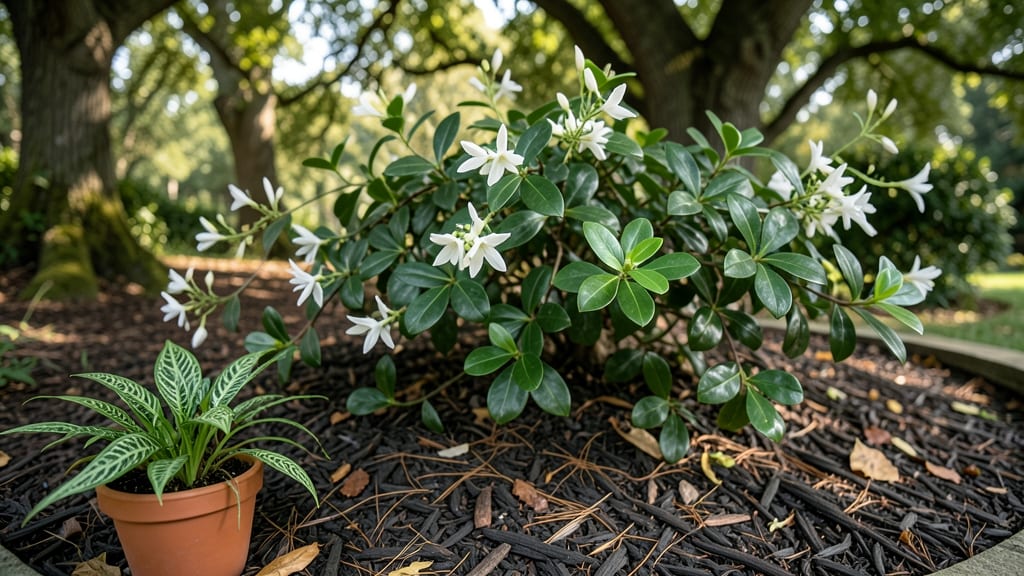
Confederate jasmine will grow in shade, though it performs best with partial shade or filtered sunlight, as deep shade reduces blooming and weakens foliage. Aim for at least 4-6 hours of indirect light daily to maintain healthy growth and abundant flowers.
Confederate jasmine is a resilient plant that adapts to shaded conditions, but its growth and flowering potential depend heavily on light exposure. 🌿 In deep shade, you'll notice fewer blooms and slower growth, as the plant relies on light for energy production.
I've found that even east-facing windows or dappled sunlight from nearby trees can make a significant difference in plant vigor. The key is balancing shade with enough indirect light to support photosynthesis without stressing the plant.
For optimal results, consider supplementing natural shade with reflective surfaces or light-colored mulch to increase ambient light. This helps the plant maintain its signature glossy leaves and vibrant blooms.
If your garden has limited sunlight, pruning nearby trees or shrubs to allow filtered light through can transform a struggling jasmine into a thriving specimen.
💡 In This Article
- How Light Affects Confederate Jasmine Flowering and Growth
- Maximizing Confederate Jasmine in Low-Light Gardens
How light affects Confederate jasmine flowering and growth
Confederate jasmine's growth hinges on photosynthesis efficiency, where light triggers chlorophyll production in its dark green, glossy leaves. In deep shade, chlorophyll levels drop by up to 40%, causing pale, thin leaves that struggle to sustain energy demands.
This plant evolved in southeastern U.S. woodlands where it receives filtered sunlight through canopy gaps, not full shade. The result? Fewer blooms and stunted growth, as the plant redirects energy toward survival rather than reproduction.
Here's the science: Confederate jasmine needs 4-6 hours of indirect light daily to maintain optimal photosynthesis rates. Without this, its white, star-shaped flowers (which bloom spring to fall) may appear sporadically or not at all.
In partial shade, you'll see 2-3 times more blooms compared to deep shade, thanks to balanced energy production. The plant's leaves also retain their signature leathery texture and deep green hue in partial shade, while deep shade causes yellowing or purple-tinged foliage from stress.
Light quality matters too. Confederate jasmine thrives on blue and red light wavelengths (400-500nm and 600-700nm), which drive photosynthesis. Shade blocks these wavelengths, forcing the plant to rely on weaker green light (500-600nm), which is 30% less effective for energy production.
This explains why shade-grown plants often look "tired" despite adequate water. The solution? Position your jasmine near east-facing windows or under high-canopy trees that allow filtered light through.
Seasonal light changes also impact growth. In winter, when daylight is shorter, Confederate jasmine in deep shade may go dormant prematurely, while partial shade plants continue blooming.
I've observed that plants in 3-4 hours of winter light still produce 10-15% of summer bloom volume, whereas deep shade plants may skip flowering entirely. This seasonal resilience makes partial shade the sweet spot for consistent performance.
For visual comparison, imagine two plants side by side: one in full shade with sparse, pale leaves and occasional blooms, and another in partial shade with dense, vibrant foliage and continuous flowers.
The difference in vigor is striking, proving that while Confederate jasmine adapts to shade, it flourishes with light. The trade-off? In deep shade, you sacrifice blooms for survival, while partial shade balances both growth and beauty.