
Blooming
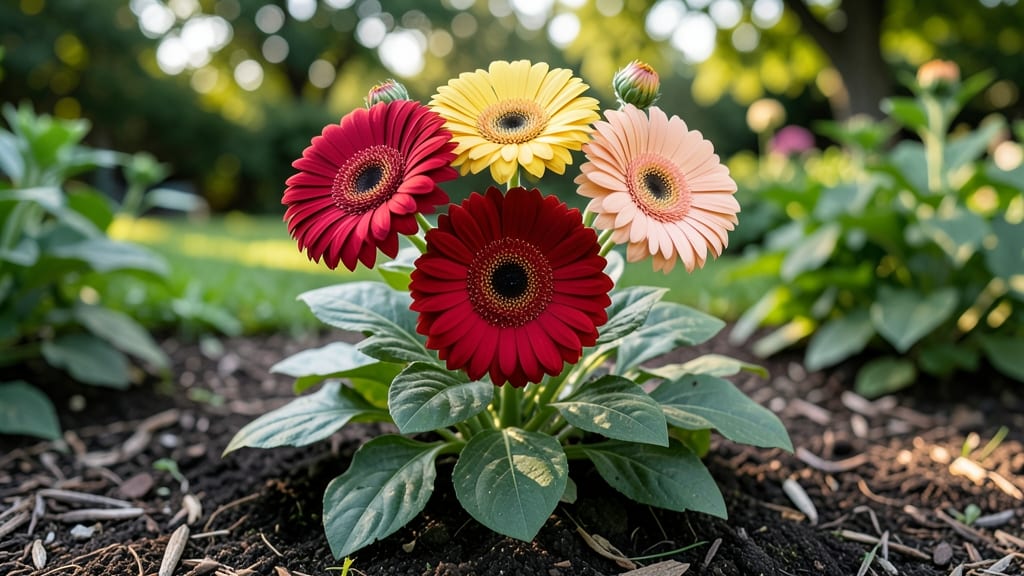
Gerber daisies don't bloom all summer continuously; their flowering occurs in seasonal cycles from early summer through fall, with intensity varying based on environmental factors like sunlight, moisture, and soil quality. Regular deadheading helps sustain their blooming period.
Gerber daisies follow natural seasonal rhythms rather than blooming nonstop. 🌸 Their flowering peaks during warm months but relies heavily on daylight hours—longer exposure triggers more abundant blooms. Perennial varieties may produce smaller bursts in spring or fall, while annuals focus energy on summer displays.
Proper care like consistent watering and balanced fertilization can help maintain vibrant blooms throughout their natural season.
What many gardeners don't realize is how sensitive these plants are to temperature shifts. A sudden heatwave or cold snap can cause blooms to fade prematurely. I've found that mulching helps regulate soil temperature, while strategic pruning removes spent flowers to redirect energy toward new growth.
The key is observing your specific variety's habits—some Gerber daisies naturally take brief breaks between bloom cycles.
💡 In This Article
- Factors Influencing Gerber Daisy Blooming Seasons
- Extending Gerber Daisy Blooms Through Gardening Tips
Factors influencing Gerber daisy blooming seasons
Gerber daisies follow a biological rhythm called photoperiodism, where their blooming responds directly to daylight length. These sun-loving plants typically need 6-8 hours of direct sunlight daily to trigger flowering.
During summer's long daylight hours, they enter peak bloom mode, producing vibrant flowers as a survival strategy to attract pollinators. When daylight shortens in late summer, their blooming naturally tapers off—this is why you'll see fewer flowers in September compared to July. 🔥
The science gets even more interesting with temperature sensitivity. Gerber daisies thrive in 60-75°F ranges, but extreme heat above 90°F can cause buds to drop before opening. I've noticed this firsthand when summer heatwaves hit—plants may produce fewer blooms or flowers that open irregularly.
Perennial varieties often have a second, smaller bloom cycle in spring when temperatures stabilize, while annuals focus all their energy on summer displays. Soil moisture plays a crucial supporting role too—consistent watering keeps roots active during these sensitive periods.
Nutrient availability creates another critical factor. Gerber daisies need balanced fertilization with higher phosphorus content (the middle number in NPK ratios) to support flower production. Too much nitrogen (the first number) promotes leafy growth at the expense of blooms.
I recommend a 10-20-10 formula applied every 4-6 weeks during the growing season. The roots also benefit from well-draining soil with a pH between 6.0-7.0—outside this range, nutrient uptake suffers, directly impacting bloom quality and quantity.
There's an important distinction between annual and perennial varieties. Annual Gerber daisies (like 'Moulin Rouge') complete their entire life cycle in one season, focusing all energy on summer blooms before dying back. Perennials (such as 'White Swan') may produce smaller bursts in spring or fall when conditions are favorable.
The key difference lies in their root systems—perennials develop deeper roots that store energy for future seasons, while annuals prioritize rapid above-ground growth and reproduction. 💫
Watering patterns also create subtle but important variations. While Gerber daisies need consistent moisture, overwatering can lead to root rot and fewer blooms. I've found that 1-1.5 inches of water weekly (including rainfall) works best, with deeper waterings 2-3 times per week during heatwaves.
The roots need to develop properly to support the plant's energy demands for continuous flowering. Mulching with 2-3 inches of organic matter helps maintain even moisture levels while protecting roots from temperature fluctuations.
One often overlooked factor is the plant's natural dormancy cycle. Even with perfect conditions, Gerber daisies will eventually enter a brief rest period. This isn't failure—it's a survival mechanism where the plant redirects energy to root and foliage growth.
You'll often see this as a sudden drop in blooms followed by fresh green growth. Understanding this cycle helps gardeners avoid unnecessary interventions that could stress the plant during these transition periods. ✨