
Light Requirements
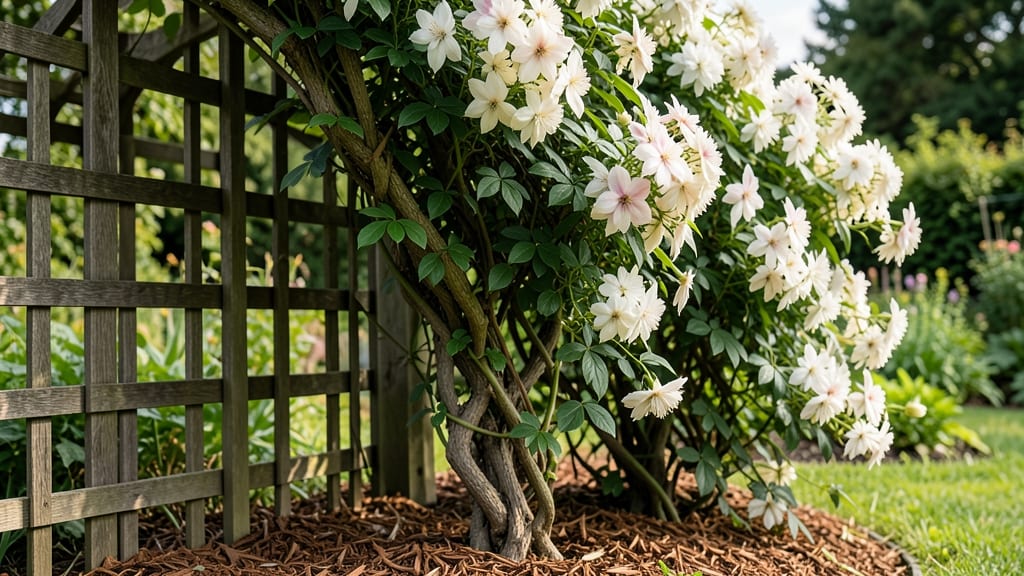
Growing a partial shade clematis vine means lush blooms where others fail—my first vine in a dappled oak grove now climbs a trellis with six-foot-tall flowers every summer. 🌿 The trick isn’t forcing full sun conditions but working with the shade: morning light and afternoon shade keeps the roots cool while still fueling those dramatic blooms.
Most gardeners assume clematis needs sun, but the right varieties thrive with just 3-6 hours of direct light—and the results are stunning without the heat stress.
Start with the right soil—clematis roots need moist but well-draining conditions, so amend heavy clay with compost or sand. A 5-gallon pot works for containers, but in-ground plants need 12-18 inches of loose soil to spread.
Water deeply once a week (more in extreme heat), always keeping the roots damp but never soggy. The key is consistency: clematis hates drying out, but soggy roots invite rot. Mulch with wood chips to retain moisture and regulate temperature—my vine hasn’t skipped a bloom since I added this step.
Pruning feels intimidating, but partial-shade clematis are forgiving. Cut back one-third of the oldest stems in early spring to encourage new growth, and deadhead spent blooms to prolong flowering. Varieties like ‘Niobe’ (deep purple) or ‘Jackmanii’ (vibrant red) handle shade beautifully, while ‘Nelly Moser’ (pink) adds a romantic touch.
With the right support—a sturdy trellis or arbor—they’ll climb 10-15 feet while still thriving in low light. The payoff? A vertical garden that outperforms sun-loving vines in hot climates.
Pair with shade-tolerant companions like ferns, hostas, or astilbe to create a layered effect. Avoid heavy feeders that compete for nutrients—clematis prefers balanced fertilizer (10-10-10) applied in early spring. The biggest mistake? Over-pruning or letting vines get too crowded.
Give them space to breathe, and they’ll reward you with months of blooms instead of a single summer burst. Your shady corner just got an upgrade.
📚 In This Guide
- What you need
- Instructions
- Tips and common mistakes
- Wrapping up and next steps
What you need
- ● Clematis plant: Choose a partial shade-tolerant variety (e.g., 'Jackmanii,' 'Niobe,' or 'Perle d’Azur'). Buy a 3- to 5-year-old vine (larger pots = faster establishment).
- ● Well-draining potting mix: 5 gallons (for container gardening) or amend garden soil with 3-5 inches of compost and 1 part perlite/sand to improve drainage.
- ● Support structure: Trellis or arbor: 6-8 feet tall (clematis loves vertical space!). Opt for metal or wooden lattice for durability.
- ● Tie-down clips or soft garden twine: 10-15 pieces (to secure vines gently as they grow).
- ● Mulch: 2-3 inches of wood chips or shredded bark (retains moisture and regulates soil temp).
- ● Fertilizer: Balanced granular fertilizer (10-10-10): 1 lb per 100 sq ft (apply in early spring).
- ● Slow-release organic fertilizer (e.g., bone meal): ½ cup per plant (for phosphorus boost).
- ● Garden trowel or spade: For digging and amending soil.
- ● Pruning shears: Bypass pruners (sharp and clean for trimming dead growth).
- ● Watering can or hose with adjustable nozzle: 1-2 gallons capacity (for deep watering).
- ● Gloves: Heavy-duty gardening gloves (protects from thorns!).
- ○ pH test kit (optional but helpful): Clematis prefers 6.5-7.0 pH.
- ● Location: A spot with 3-6 hours of dappled shade (morning sun + afternoon shade works best). Avoid deep, heavy shade (e.g., under dense trees).
- ● Soil prep: Test soil drainage—clematis hates soggy roots. If clay-heavy, mix in sand or coconut coir.
- ● Timing: Plant in early spring or fall (avoid extreme heat or frost).
Step-by-step guide to cultivating a partial shade clematis vine
Here's how to coax lush, vibrant blooms from a clematis even when full sun isn't an option.
🌱 Step 1: Select the Right Clematis Variety for Partial Shade
Not all clematis thrive in partial shade, so choose varieties specifically bred for lower light conditions like 'Jackmanii', 'Nelly Moser', or 'Vyvyan Pennell'. These cultivars handle 3-6 hours of morning sun with afternoon shade better than sun-lovers. Avoid varieties requiring full sun, as their blooms will be sparse and weak.
I always check the plant tag for light requirements before purchasing—some nurseries even label clematis as "partial shade tolerant." Plant in early spring when roots establish before summer heat stress. The key is selecting a vine that matches your light conditions from the start, not trying to force a sun-loving variety to adapt.
🪴 Step 2: Prepare the Planting Site with Proper Support
Clematis needs a sturdy trellis, arbor, or fence to climb—install this before planting. The support should be at least 6 feet tall to accommodate mature growth. I use a metal trellis for durability, but wooden arbors work too. Bury the support 12-18 inches deep for stability, especially in windy areas.
Dig a hole twice as wide as the root ball but no deeper. Amend the native soil with 3-4 inches of compost mixed into the bottom and sides of the hole. Clematis roots are shallow but extensive—this ensures they have nutrients without competing with nearby plants. A 4-inch layer of mulch around the base (but not touching the stem) helps retain moisture while protecting roots from temperature swings.
☀️ Step 3: Plant with Correct Depth and Orientation
Clematis stems are prone to rot if buried too deep, so plant with the top of the root ball 2-3 inches below soil level. This encourages strong root growth while keeping the crown just below the surface. I mark the planting depth with a stake before removing the plant from its container—this prevents over-deepening, which suffocates the vine.
Position the vine so the strongest stems face the direction of the light source. If planting near a wall or fence, leave 12 inches of clearance—this prevents moisture buildup against the structure, which leads to fungal issues. Water deeply immediately after planting to settle the soil and eliminate air pockets around the roots.
💧 Step 4: Water and Fertilize for Partial Shade Success
Partial shade clematis needs consistent moisture—water when the top 2-3 inches of soil feel dry. I check this by inserting a finger into the soil; if it's dry at that depth, it's time to water. Overhead watering can promote fungal diseases, so I use a soaker hose or drip irrigation directed at the base. Aim for 1-1.5 gallons per week during the growing season.
Fertilize lightly in early spring with a balanced 10-10-10 formula, then switch to a low-phosphorus, high-potassium fertilizer (like 5-10-10) once blooms appear. Too much phosphorus encourages leafy growth at the expense of flowers. I avoid fertilizing in late summer—this prevents tender new growth that won't harden off before winter.
✂️ Step 5: Prune Strategically for Partial Shade Conditions
Partial shade clematis typically falls into Group 1 or 2 pruning categories—check your variety to confirm. Group 1 (early bloomers) should be pruned immediately after flowering, while Group 2 (late bloomers) gets a late-winter prune. Never prune in fall, as this removes next year's flower buds on Group 1 varieties.
I always prune to 2-3 healthy buds above a strong joint—this encourages bushier growth and more blooms. Remove any dead, crossing, or weak stems first, then thin the center to improve airflow. Partial shade vines are more prone to powdery mildew, so I sterilize pruners with rubbing alcohol between cuts and dispose of infected stems immediately.
Tips & tricks for perfect partial shade clematis cultivation
These tried-and-tested strategies will help you coax vibrant blooms from your clematis even in low-light conditions.
Variety Selection Matters: When choosing your clematis, prioritize varieties like 'Jackmanii' or 'Nelly Moser' that explicitly thrive in partial shade. These cultivars have adapted to handle 3-6 hours of morning sun with afternoon shade—critical for avoiding sparse blooms. I always verify the plant tag for "partial shade tolerant" labeling, as this ensures you're not accidentally selecting a sun-loving variety that will struggle. Confession: I skipped this step early on and ended up with a vine that produced only a handful of weak blooms.
Support System Stability: The 6-foot minimum height for your trellis or arbor isn't just a suggestion—it's essential for accommodating mature growth while preventing breakage. I learned this the hard way when a poorly anchored trellis collapsed under a heavy vine during a summer storm. Bury the support 12-18 inches deep for maximum stability, especially in windy areas. For extra security, I tie the trellis to a nearby sturdy post using flexible garden twine.
Planting Depth Precision: Getting the planting depth right is absolutely critical—burying too deep suffocates the crown, while planting too shallow leaves it vulnerable to temperature swings. The 2-3 inches below soil level guideline creates the perfect balance. I mark the planting depth with a stake before removing the plant from its container to ensure accuracy. This simple step prevents the stem rot I once experienced after planting too deeply in my enthusiasm.
Pruning Precision: When pruning your partial shade clematis, always aim for 2-3 healthy buds above a strong joint. This targeted approach encourages bushier growth and more abundant blooms. I sterilize my pruners with rubbing alcohol between cuts to prevent spreading powdery mildew—a common issue in partial shade conditions. Remember, Group 1 varieties (early bloomers) should be pruned immediately after flowering, while Group 2 varieties get their prune in late winter. Never prune in fall, as this removes next year's flower buds.
Pro Tips for Partial Shade Clematis Vine
- These tried-and-tested strategies will help you coax vibrant blooms from your clematis even in low-light conditions.
- Variety Selection Matters: When choosing your clematis, prioritize varieties like 'Jackmanii' or 'Nelly Moser' that explicitly thrive in partial shade.
- Support System Stability: The 6-foot minimum height for your trellis or arbor isn't just a suggestion—it's essential for accommodating mature growth while preventing breakage.
Frequently asked questions
Got questions about growing partial shade clematis? You’re not alone! Here are some of the most common concerns—and their solutions—to help your vine thrive in less-than-sunny spots.
What are the best clematis varieties for partial shade?
Look for early bloomers like Clematis montana or Clematis armandii, which tolerate shade better than late-season varieties. Large-flowered clematis (e.g., Jackmanii) also adapt well if given morning sun. Avoid Clematis viticella—it craves full sun!
How often should I water a clematis in partial shade?
Water deeply but infrequently—about 1-2 times per week in dry spells. Partial shade means slower evaporation, so the soil stays moist longer. Mulch (2-3 inches) helps retain moisture and regulate temperature. Overwatering is the #1 killer—let the top inch dry between waterings.
Why are my clematis leaves yellowing in partial shade?
Yellow leaves often signal overwatering or nutrient deficiency. Check drainage—clematis hates soggy roots! Amend soil with compost and a balanced fertilizer (10-10-10) in early spring. Yellowing on older leaves? It’s normal aging; new growth should stay vibrant.
Can I grow clematis in full shade? (And what’s the alternative?)
Clematis struggles in full shade but can survive with bright indirect light (e.g., under deciduous trees). For deeper shade, try alternatives like honeysuckle, climbing roses (e.g., ‘New Dawn’), or ivy. If committed, choose Clematis circinata—it’s the most shade-tolerant!
Do I prune partial-shade clematis differently?
Pruning depends on your variety:
- Group 1 (early bloomers): Prune right after flowering to encourage next year’s blooms.
- Group 2/3 (late bloomers): Prune in early spring (before buds swell) to remove dead wood.
Wrapping up and next steps
Growing a partial shade clematis vine is a rewarding way to add vertical elegance and vibrant blooms to your garden—even in low-light spots! 🌿 With the right variety, soil prep, and care, these versatile climbers thrive where others struggle.
Whether you’re a beginner or a seasoned gardener, the key is patience and attention to their unique needs.
Ready to transform your space? Start by selecting your clematis variety (like Jackmanii or Niobe) and give it the love it deserves—your garden will thank you with stunning, long-lasting beauty! 🌸