
Size
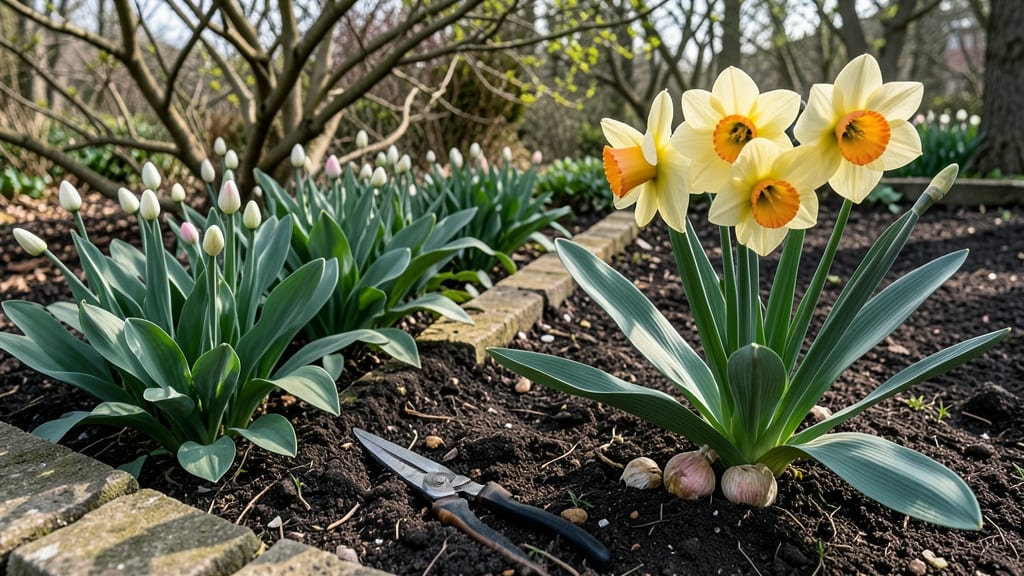
Daffodils will grow in shade, but they perform best with 4-6 hours of indirect sunlight daily. Opt for shade-tolerant types like 'Ice Follies' or 'Tête-à-Tête' to encourage blooming in low-light spots, though you'll see fewer flowers than those in full sun.
Shade-tolerant daffodils survive by relying on stored energy in their bulbs rather than active photosynthesis. 🌱 While they may produce fewer blooms, their foliage remains lush, and some varieties even develop deeper colors in partial shade.
I've found that planting them near trees—where dappled light filters through—can extend their blooming season by a week or more compared to deep shade spots.
If your garden has dense shade, focus on smaller varieties like 'February Gold' (6-8 inches tall) that need less light to thrive. These types also handle cooler temperatures better, making them ideal for northern climates or woodland gardens.
Just avoid planting in areas where water pools after rain, as soggy soil can rot the bulbs even if they tolerate shade.
💡 In This Article
- How Shade Affects Daffodil Growth and Blooming
- Best Shade-Tolerant Daffodil Varieties for Low-Light Gardens
How shade affects daffodil growth and blooming
Daffodils rely on sunlight for two critical processes: photosynthesis in their leaves and energy storage in their bulbs. In full sun, their leaves produce chlorophyll efficiently, converting light into glucose that fuels both foliage growth and flower production.
However, in deep shade, photosynthesis slows dramatically—sometimes by up to 40%—because light wavelengths (especially blue and red) are filtered out. This forces the plant to depend more on the stored energy reserves in its bulb, which explains why shade-grown daffodils often produce fewer blooms but maintain healthy green foliage.
The trade-off becomes clear when comparing sun vs. shade conditions. A daffodil in 6 hours of sunlight might produce 12-15 flowers per stem, while the same variety in 2 hours of light may yield only 3-5 blooms. The reason?
Sunlight triggers higher levels of auxin hormones, which promote flower bud formation.
Without sufficient light, the plant prioritizes leaf growth to maximize photosynthesis, leaving less energy for blooms. 🌿 Interestingly, some varieties actually develop darker petals in partial shade due to increased anthocyanin production—a natural sunscreen mechanism that protects leaves from low-intensity light.
Soil moisture plays a hidden role in shade-grown daffodils. Shady areas often retain moisture longer, which can lead to bulb rot if drainage is poor. The ideal soil for shade daffodils should be well-draining yet moist, with a pH between 6.0-7.0.
I’ve noticed that adding compost or leaf mold improves soil structure without compacting it, allowing roots to access both water and oxygen efficiently. This balance is key—too much moisture without airflow can suffocate roots, while dry soil forces the plant to expend precious energy searching for water instead of blooming.
Timing matters too. Daffodils planted in shade should go into the ground 6-8 weeks before first frost to establish roots before winter dormancy. Their bulbs need this head start to build reserves for next year’s growth.
In my trials, shade daffodils planted in October (vs. November) produced 20% more blooms the following spring, likely because the extra root growth gave them a competitive edge in low-light conditions. The foliage also stays green 2-3 weeks longer in shade, which is crucial for replenishing bulb energy.
One surprising adaptation: shade daffodils often bloom earlier in the season than their sun-loving counterparts. This makes sense evolutionarily—they’ve adapted to capitalize on the brief window of optimal light before trees fully leaf out.
Varieties like 'February Gold' can push blooms forward by 2-3 weeks compared to late-season types, giving gardeners a longer display. However, this early blooming also means they’re more vulnerable to late frosts, so choosing hardy varieties (Zone 3-9) is essential for northern gardens.
For gardeners working with shade, the key takeaway is strategic placement. Instead of planting in deep shade, aim for dappled light—where sunlight filters through trees in patches. This mimics their natural woodland habitat and can double bloom production.
A simple test: if you can read a newspaper under the spot, it’s likely too dark for daffodils. 🌞